A simpler way
to care for
your feet
A three-minute daily routine for people with bunions (hallux valgus). Combining gentle toe alignment and active foot strengthening, right at home.
your big toe
foot muscles
while brushing your teeth
Share your feedback in our short survey.

Understanding bunions
What is hallux valgus?
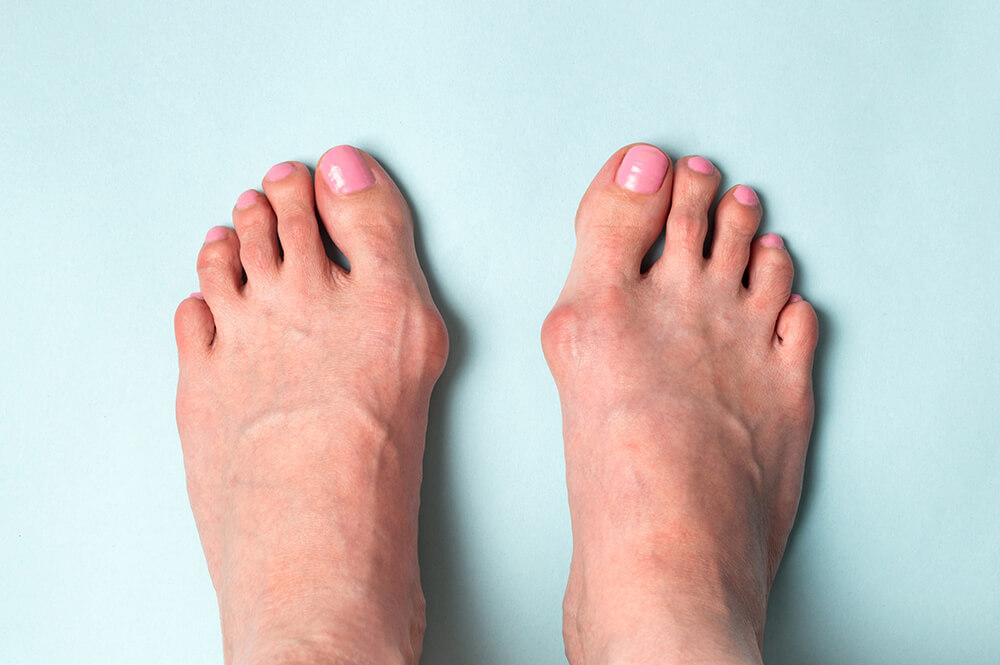
Hallux valgus, commonly called a bunion, is a deformity in which the big toe deviates towards the smaller toes. It can cause pain, footwear difficulties and limitations in daily activities.
Hallux valgus can get worse over time, but it is not inevitable.
In a seven-year study of adults aged 50 and over, 33.6% experienced progression of hallux valgus.
Menz et al., Arthritis Care & Research (2023). View study ↗
Three elements. One simple routine.
The Foot Pad combines gentle toe alignment, active foot exercise and a daily habit.
Passive alignment
Integrated separators guide the big toes towards a straighter position while standing.
Active strengthening
Gentle big-toe presses engage the muscles involved in toe control and foot stability.
Daily consistency
Pair the exercise with brushing your teeth to make regular practice simple.

The product
The Foot Pad
A simple rubber-based mat with integrated toe separators and a responsive surface for big-toe pressing exercises.
No equipment setup. No complicated exercise sequence. Just step onto the mat and practise while brushing your teeth.
How to use it
Three minutes, while brushing your teeth.
Place
Stand comfortably on the mat, placing each separator between the big and second toes.
Press
Gently press your big toes down against the responsive surface. Keep the movement controlled and comfortable.
Repeat
Continue the gentle press movement throughout your three-minute routine.
Feel the movement. The responsive surface provides tactile feedback as you press your big toes into the mat.
Evidence-informed foot care
What does the research say?
The American Orthopaedic Foot & Ankle Society (AOFAS) supports conservative treatment before surgery for hallux valgus. Clinical studies of conservative hallux valgus management have investigated foot exercises, toe separators, taping and combinations of these approaches. Research suggests benefits for pain and toe alignment, particularly when exercise is combined with external support.
Pain
Exercise and external support have been associated with reduced hallux valgus pain in clinical trials. Combining approaches provide additional benefit.
Function
Conservative exercise programs can support foot muscle function and movement control, with potential benefits for everyday activities such as walking.
Alignment
Some clinical studies report reductions in hallux valgus angle following exercise, particularly when combined with external support.
Why combine alignment and exercise? A 2021 systematic review identified exercise combined with toe separators as a promising approach to improving hallux valgus alignment. A 2026 review also found advantages for exercise combined with external support. These findings inform the Foot Pad's design; they do not establish an equivalent effect for every exercise device or routine.
Scientific references
1. Menz et al. Incidence and Progression of Hallux Valgus: A Prospective Cohort Study. Arthritis Care & Research, 2023. Read study ↗
2. Adjusted Indirect and Mixed Comparisons of Conservative Treatments for Hallux Valgus: A Systematic Review and Network Meta-Analysis. International Journal of Environmental Research and Public Health , 2021. Read study ↗
3. Zhu et al. Effects of Exercise Combined with External Support on Hallux Valgus Angle and Pain: A Systematic Review and Network Meta-Analysis. Foot and Ankle Surgery, 2026. Read study ↗
Do you have a bunion?
Help us understand your experience, what concerns you and whether a simple daily foot exercise product would be useful. Your feedback will shape the Foot Pad.
Take the customer survey → About 2–3 minutesAre you a healthcare professional?
Share your perspective on combining toe alignment and active strengthening, including clinical relevance, usability and priorities for further testing.
Take the professional survey → About 2–3 minutesFrequently asked questions
What is the Foot Pad?
The Foot Pad combines integrated toe separators with active big-toe pressing exercises in one simple home routine.
Can hallux valgus get worse?
Yes. In a seven-year study of adults aged 50 and over, approximately one in three experienced progression of hallux valgus. Progression is not inevitable, and the study does not show that any particular exercise prevents it.
Can exercises help with bunions?
Research suggests that conservative exercise programs, particularly when combined with external support, can improve pain and hallux valgus angle in some people. Effects depend on the intervention and individual circumstances.
How long before I notice results?
Many published exercise interventions are assessed after eight to twelve weeks. Pain, function and alignment may respond differently. This is a research-based review period, not a guaranteed timeline for the Foot Pad.
Can the Foot Pad straighten my bunion?
The separators gently position the big toes during use, while the pressing movement provides an active foot exercise. Clinical research supports exploring this combination, but permanent correction cannot be promised.
How often should I use it?
The Foot Pad routine takes three minutes and fits alongside brushing your teeth. Research-based exercise programs vary in duration, frequency and intensity.
Is the Foot Pad available to buy?
The Foot Pad is currently in product development. We are collecting feedback from potential users and healthcare professionals to guide the next stage.